Emperor Franz Joseph’s 68-year reign provided the Austro-Hungarian Empire with unusual stability – at first glance. But below the surface, he and his glittering realm were suffering a series of losses that depleted national resources and credibility. FJ ascended the throne in 1848, after his uncle Ferdinand abdicated in a Hungarian Revolution deal, that included giving Hungary it’s own parliament, and changed the Empire’s name from just Austrian, to Austro-Hungarian.
Twenty years later, in 1868, his brother Maximillian, after a poorly thought-out adventure to turn Mexico into a monarchy, was tossed from the Mexican throne and executed by a revolutionary firing squad. Then, in 1871, his poorly equipped armies lost a war with rapidly modernizing Prussia, allowing the northern Germanic peoples to consolidate into single nation, weakening Austria’s claim to lead Germans. Next, his son Rudolf, a long-time depressive, committed suicide, taking away his presumptive heir. And then, in perhaps the cruelest blow came in 1898, when Franz Joseph’s beloved wife, Empress Elizabeth, was killed by an assassin’s shot.
By the turn of the 20th century, the Emperor was dizzied with loss. He withdrew from much of the affairs of state, appointed his nephew Archduke Franz Ferdinand as heir, and spent his later years as a recluse. And yet, it was the midst of Austria-Hungary’s greatest period, Vienna in the Austrian west, and Budapest in the Hungarian east erected glorious, glittering buildings, museums, bridges, tunnels, plazas, new parliaments, and palaces. A web of railroads wrapped across the Empire, poets wrote, composers composed, universities brought forth new ideas, and for a time, it seemed like Austria-Hungry – especially Vienna – was the center of world culture and thought.
Then, a grenade killed Franz Ferdinand, the First World War began, and in a few, short years, the Empire was split into eight different nations. The glittering stopped, leaving behind shards of greatness.
Ever since I first learned about Emperor Franz Joseph, I’ve been obsessed with the many what-ifs of his reign. What if he had modernized his army earlier? What if his son hadn’t killed himself? What if his wife hadn’t been killed? The Empire could have shined on, Germany wouldn’t have ascended, and maybe there wouldn’t have been a first or second world war. Maybe nationalism wouldn’t have been as important and polyglot empires would have churned on – and Vienna would have remained the center of European culture.
There’s an argument to be made that the failures of Franz Joseph created our political world more than any other man, while his empire’s fragile stability – a time that fostered Schubert, Freud, Kafka, Liszt, Hertzl, Goethe, and so many more – created our cultural world more than any other.
This history was hard to avoid during our visits to Budapest and Vienna last week. In both cities – four days in each – we wove through narrow streets and wide boulevards stocked at every turn with what we called “Empire Stuff”. Rococo palaces, museums, institutes, and apartment blocks dating to the 18th century. In many ways, it seemed as if the cities’ edifices were frozen in 1890, and then sprinkled with a few changes after 1945.
As a child of the Cold War, I’d always thought of Vienna and Budapest as dens of spies. The narrow streets would be lined by fancy empire-period apartments, street cars rumbling through the streets as citizens hustle from basement cafés to snowy doorways.
It turns out that – although I didn’t meet any spies – the cities are still look like that!
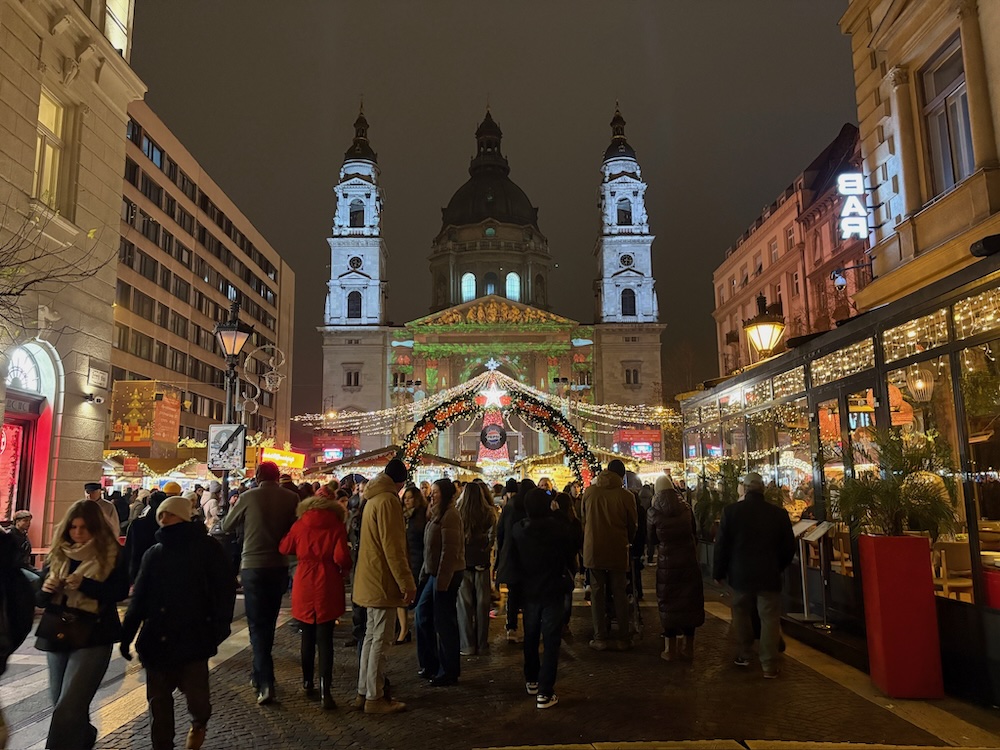
Arriving a few days before Christmas, we found the twin cities of Buda and Pest, as cold and grey but bustling, filled with Christmas markets in almost every public square. Hot chocolate, mulled wine, spicy sausages, and ever present langos, potato pancakes topped with Nutella, sour cream, or more sausages.
The people of Budapest have a “look”. Women with perfect makeup, long hair, and heels. Men with boldly marked designer clothes and product in their hair. They laugh loudly, lounge in cafés sited every 200 feet, and move with a kind of purposeful stroll from place to place, rarely rushing.
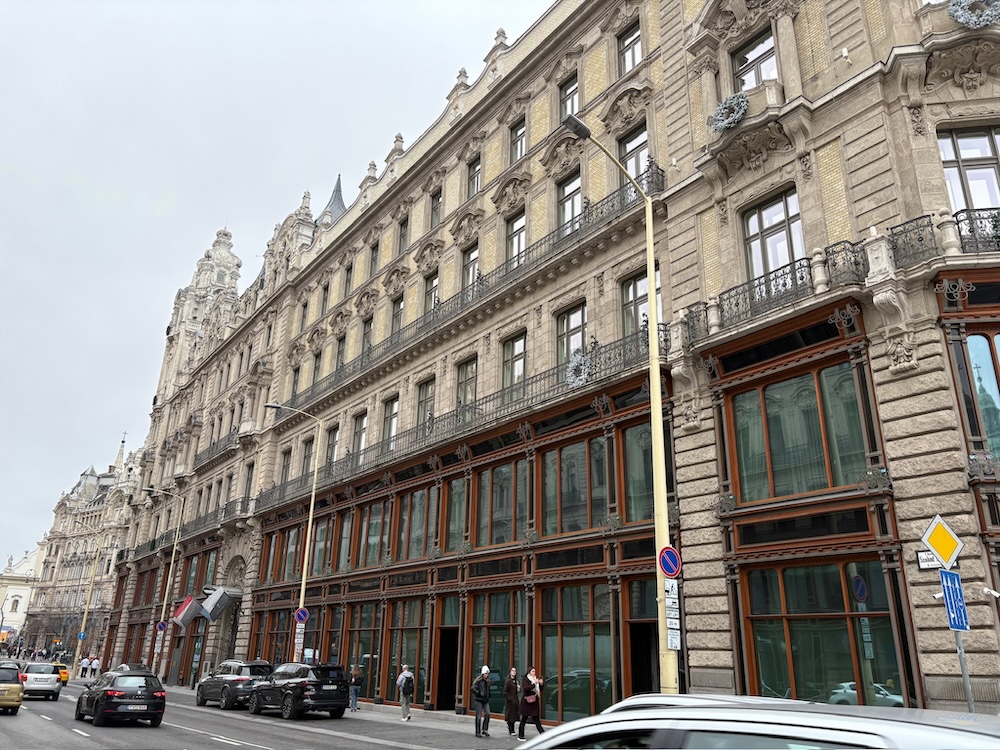
In the center city, giant apartment blocks reaching five or six stories, built centuries ago and remodeled a dozen times since then, are tightly knit. Major streets have businesses, but the side streets are where the action lives, jammed with tiny shops, cafes, and restaurants of every kind. I was surprised to find Thai, Ethiopian, Cantonese, Mexican, and so much more. A friend in Chicago alerted me to the city’s Cold War specialty in dentistry, and indeed, I couldn’t help but notice tons of pristine dental “salons” beckoning in patients. If I had more time, I would have dropped in for an inexpensive cleaning.
Occasionally, passageways between Budapest’s giant apartment blocks allow locals in the know to move through the blocks stacked with businesses. If you’re wise to the routes, you’re rewarded with even more shops and drinking establishments, mostly attuned to locals, rather than tourists.
Our AirBnB, right off Deák Ferenc tér, one of the main squares, was new, and relatively well-appointed. The building probably dated to the late 18th century, with two-foot thick stone walls that barely let in a sound from the street. Roll-down blackout shutters made our place feel like a fortress at night – a welcome respite from the busy boulevard and busy Christmas market in the square nearby.
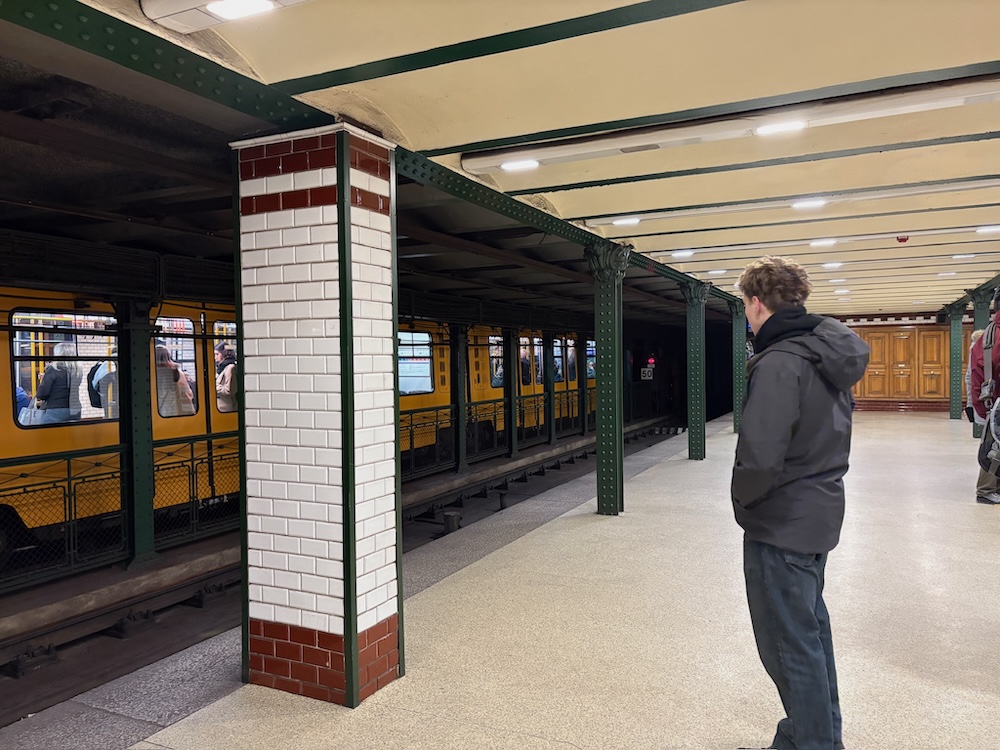
Budapest’s subway reminded me of Glasgow’s, with short ceilinged, four-car trains and tiny stations. There’s no advertising on the trains or stations, and no turnstile at the entrance. Fares are managed with an app. You pass your app past a registration point for a QR code for each trip, and if you’re unlucky, an attendant asks for your code at the exit.
We spent our time visiting the city’s giant Central Market, peeking at massive gothic churches, eating paprika-heavy sausages at Christmas markets, and making a special trip to the City Park’s massive Szechenyi Thermal Baths.
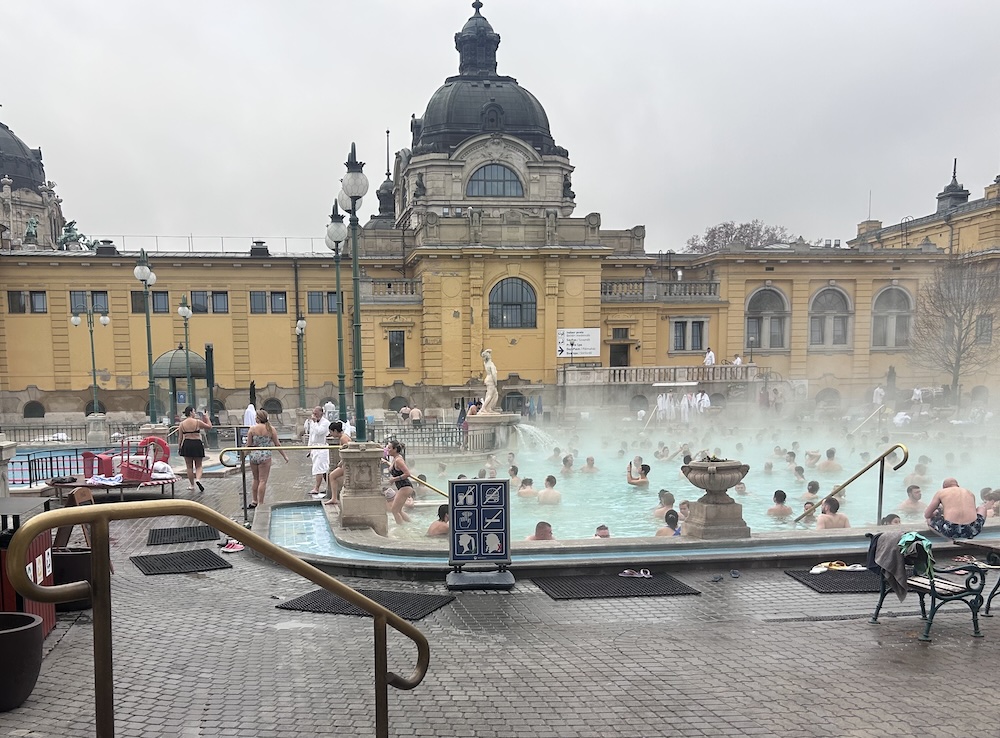
Budapest is built upon a series of hot springs, which paired with the many cafes, seem to foster a culture of steady contemplation. Szechenyi is gigantic, with three huge outdoor pools, four more internal pools, and a warren of massage rooms and mud spas. On the below-freezing day we got there, perhaps two hundred visitors crouched in the hot, steaming outdoor pools, enjoying their “medicinal” value, as the brochures advertise. Cafes line the perimeter, but in the winter, only a few robe-clad people supped in the cold. Most darted from the pool, wrapped themselves in a towel, and made for the warmth of the clean, indoor changing rooms as fast as they could.
The city is dotted with statues and busts of Hungarian philosophers, musicians, poets, and kings from the twelfth to fifteenth centuries. Budapest has been under somebody else’s thumb for most of history – Ottomans, then Austrians, Nazis, Soviets. So for a long time, the safest history was from the “before times” when the Ottomans swept in the mid-1400’s. After that, politics became a dicey proposition, so it stands to reason that Hungarians shifted from politics to lionizing generations of bourgeois thinkers and artists.
Statues, palaces, institutes, bridges, and boulevards cover central Budapest. Some of it from the 18th century, but most of it clearly from Franz Joseph’s incredible reign before the great fall. Around a corner, another palace. Walk a street, end up in a square with a statue. “Empire Stuff” we called it, the kind of edifices that only come to a city located in the center of an empire, because no other place would have the hubris to pave their streets with so much self-congratulation. “We’re awesome, check it out,” practically every other building seemed to say.
Yet, a reminder of what Hungarians endured after Empire is presented in the very dreary yet incredible Terror Museum, located in the building that once housed Hungary’s localized Nazis, the Arrows Cross Party, and then their localized version of the KGB, the AVH. Working from the top, the building walks you through Nazification, the Holocaust, and the grip the Arrow Cross once had on Hungarians. Then, through Soviet times, you walk through the actual office of the head of AVH, details the names and faces of people executed for thought crimes, eventually bringing you down an elevator to the basement jails, with a video narration from the man tasked with cleaning up dead bodies from the daily executions – carried out in the dank cells you stand in.
Gutted by walking the execution rooms of the Terror Museum, we decided to recover with lunch. Since my wife is gluten free, she took the lead to find a spot that worked for her, and navigated us to an entirely gluten free pizza place a few blocks away. Like so many restaurants in central Budapest, it was a cozy, high ceiling space wedged into an outwardly colorless 18th century apartment block. It wasn’t Chicago-level pizza, filled with lots of strange toppings (I had one with sliced Hungarian sausage and some strange cheese with no tomato sauce, good but…not?).
The important thing about Budapest restaurant menus (and also Vienna, we discovered) is that almost every menu choice is labeled with a standard code for various allergies (1=gluten, 2=celery, 3=dairy, 4=nuts, etc.) printed on the bottom of the page, normalizing the need for allergy clarification and bypassing the sniffiness waiters give you when you ask about allergies. We found this allergy code everywhere, from upscale spots, to small cafes, to corner langos joints.
While central Budapest has no shortage of food from around the world, the Hungarian meals we sat down to were fantastic. Goulash, chicken paprikash, chimney cake, and lots of great local wine. The variety of local sausages were great and as an American in Europe, it’s exciting to encounter a culture that really uses hot spices. Talking to a sausage maker in a market, Nicolas and I were sampling the wares, when the vendor asked, “You like really spicy?” Oh, yes please! we responded. He vigorously cut a slice for each of us and handed it over with a challenging smile. When neither Nicolas or I cracked – it was not even close to a Chicago taqueria salsa – he was visibly disappointed until we ordered up a link to take home.
We left Budapest for Vienna by train on Christmas Eve, through the city’s very Sovietesque Keleti train station. It lacks a concourse, so we stood on the platform open to swirling December winds, looking at somewhat battered blue and white Hungarian MÁV trains. When our train was announced, a red Austrian OBB RailJet train, we practically bolted to the gleaming luxury of the West.
Leaving the station only 12 minutes late, our two-and-a-half hour ride to Vienna comprised of a bajillion stops at tiny Hungarian towns with dusty, neglected homes, as we trundled at a snails pace. But then passing over the border, the train quickened to 160 kph, stopped only once more and blazing through a landscape packed with wind turbines and tidy burgs. Despite the Schengen Zone, the line between East and West was as clear as ever.
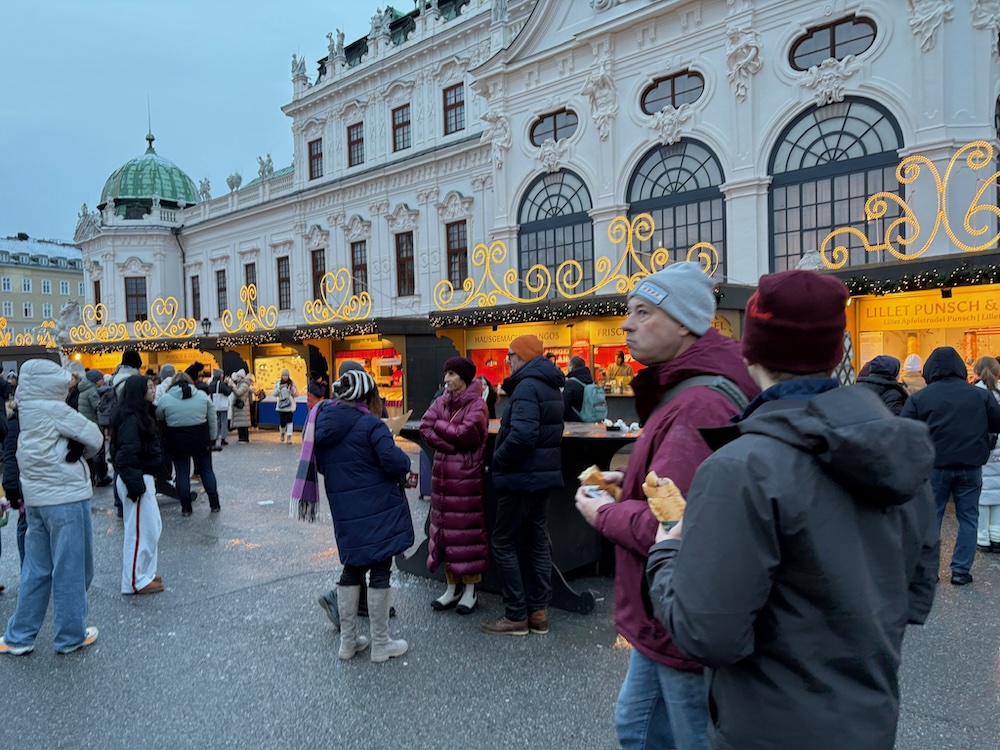
Like Budapest, it was cold, rainy, and grey in Vienna. Our arrival plan was to hustle from the train station to our Airbnb, find a Christmas market to eat, and maybe buy enough pastries and food to get us through the next day, Christmas, when we had a dinner reservation. Off our train at 2:30, then a quick city bus to our apartment, we dumped our bags and walked 15 minutes to the Christmas market at the Belvedere Palace. As you’d expect, it was gorgeous, full of people drinking glögg and schnapps, but not much food. Lots of cool craftsworkers, a few pastries and bratwurst shoved into a fresh roll (OK, this was good), but not enough for my gluten-free wife and a ravenous 17-year old son.
Scrolling through our phones, we soon realized: Everything in Vienna closes at 1:00 pm on Christmas Eve. Despite there being Billa or SPAR grocery stores every four blocks, they were all closed. Outside Christmas markets, which all closed at 6:00 pm, the streets were shuttered. We began to think: Christmas would be a very hungry day.
Then, Teresa said, “What about the train station?” It was now 4:30. Maybe they’d be open until 5:00? Apple Maps said it was an 18 minute walk. We launched into a mad dash for Vien Hauptbahnhof, the city’s main train station.
Through the emptying streets of a city we hadn’t been in for three hours. A few coffee shops open here and then a restaurant with lights on: “Maybe we should just have dinner there?” “No! To the station!” Empty streets with no cars, but in rule-abiding Austria, lone pedestrians standing at the corner, waiting for lights to change. No jaywalking here.
Finally, Vien Hbf! Jammed with people. Train boarding calls. Stores! Are they open? Not this one. Not this one. Billa? Closed. Teresa began a systematic search of the station map. Nicolas and I bolt, looking for something open. Yes! A bread shop (these are all over Vienna) selling loaves of bread, ground coffee, pre-sliced cheese and meat. We grab whatever we can. As we do, the fear of a hungry Christmas passes, and we begin to relax. We encounter Teresa, with our bounty, she’s found a Thai noodle place in the station’s food court that’s gluten free where we can eat dinner.
Christmas was saved!
After a lazy morning of coffee, salami, and cheese slices (which were pretty good, by American standards), we strolled out of our apartment on MargaretenStraße with a plan to visit one of the city’s art museums, the Leopold Museum, and then Stephensdom, the central part of the city with St. Stephen’s Cathedral, and of course, a Christmas Market.
Although we’d taken a bus the day before, this time we walked a few blocks to catch a tram, the Straßenbahn. Vienna’s public transit works like this: You use the app, WeinMobile, to buy a pass for the time length you want, €9.70 for a day, €21.90 for a week, €294 for a year, and then you ride busses, trams, trains, subways, as much as you want. There are no fareboxes on busses and trams. No turnstiles or gates in stations. You just get on and off. And if you live there, you basically get unlimited rides for less than an euro a day.
The convenience of transit in Vienna is mind boggling. S-bahns go to the suburbs. U-bahns (the subway) are longer distance city rides and run every four minutes, Straßenbahn are like express busses that stop every four or five blocks that run every eight minutes or so. And busses connect neighborhoods that run every ten minutes. It’s all in the app. Times, bus locations, fares.
And you just get on and off. No thinking. Just do it. With this sort of convenience, why would you ever take a car? And people take their shopping, boxes of stuff, kids, strollers, dogs! Public transit in Vienna is like walking down the street, everything happens there, it’s just one expedited step towards your destination. As we saw it, Viennese public transport creates a great leveling effect where everything in Vienna and it’s environs are accessible to everyone at a cost lower than just about anywhere else in the Western world. To put it in a US perspective: Transit in Chicago isn’t nearly as comprehensive as Vienna, but it costs about five times as much on a daily basis ($2.50 each way), where as in Vienna I can get on and off as much as I like for a much lower cost. Why wouldn’t I visit every part of the city and suburbs as much as I like? Work anywhere, play anywhere, go to events anywhere? Even as a visitor, you begin to see all kinds of secondary effects when you realize how easy it is to get places: You just want to go!
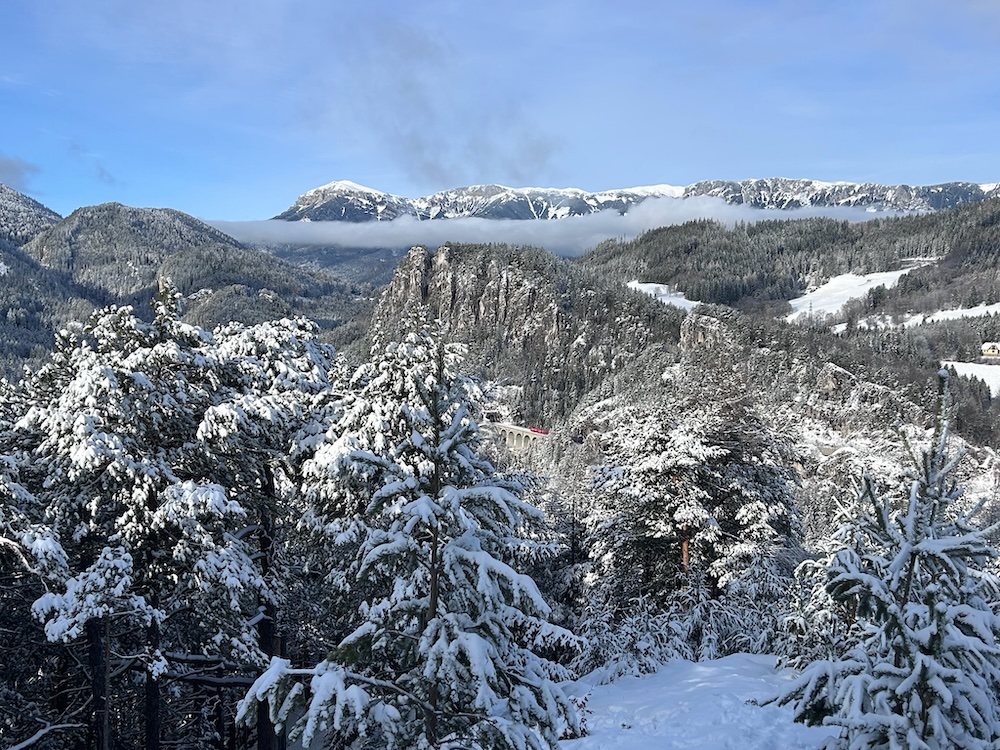
And go we did. Jumping ahead, we’d purchased train tickets for the day after Christmas to visit Semmering, a ski town in the Austrian Alps just over an hour away. The plan was a mountain hike, lunch in town, then tobogganing on the mountain. On the train at 8:25, off by 9:40, we consulted an Austrian government website with winter hike trail maps and found the trailhead just behind the station. After 15 minutes of hiking we were deep into a mountain trail, groomed, but covered with an inch of powder, past shambling, empire-era hotels, and leading us to stunning vistas, including “The 20 Shilling View”, so-called because it had once graced the back of Austria’s 20 shilling note.
After a three hour hike in the snow, we stopped in an Italian cafe in town for lunch. Then, to the hill, where we got day-long lift tickets for €45 each and rented toboggans. A quick gondola ride up and then a two-mile long run just for toboggans, with a beer and hot chocolate stop in the middle.
Tobogganing on a real mountain is fast. You really don’t have a way to control speed or direction, except with your heels, and – at least here – we were going fast. To slow people down the Semmering crew put in moguls, which effectively makes you go airborne every 100 feet or so. You’ve got to be careful not to plant your heels on landing, or else you catapult forward on landing, flipping over the sled, landing face first in the snow at about 20-miles per hour.
Yes, I did this. Multiple times.
After a few runs and hot chocolate, we got to the bottom of the hill, and walked a mile or so to the station, on a train and back to Vienna in time to change clothes to head out to dinner.
Again, the idea of accessible amenities, shocked these Americans. Everything in the city, nature, skiing, it’s available for a reasonable price, by an easy train ride. There are a few major American cities where you can get to nature quickly – Portland, Denver, maybe Albuquerque – but you always need to drive. In most American cities, you need to drive for hours. It’s at least a two hour drive from Chicago to get to real hiking trails.
We think we have everything in America. Until we realize the things we’ve been missing all along.
On Christmas Day the Viennese still in town hit the streets. Central Vienna was abuzz, with many of the museums open, and the Christmas market in front of St. Stephen’s Cathedral packed with merrymakers, mostly Austrian from what I could tell by the amount of German I heard.
As in Budapest, the Viennese have a “look”. Fulfilling a stereotype, I saw lots of leather pants, but mostly sleek elegance. Trim clothing for men and women, with a kind of efficiency. Everyone looks clearly pays attention to their look, like in Paris, but they lack the fussiness of Parisians. At one cafe, I saw a middle aged man unironically wearing wraparound glasses with bug eyed yellow lenses. With a trim jacket with thin lapels and slicked back, salt-and-pepper hair, he looked good. Outside the galleries of New York and LA, you’d be hard pressed to find someone in the US like this.
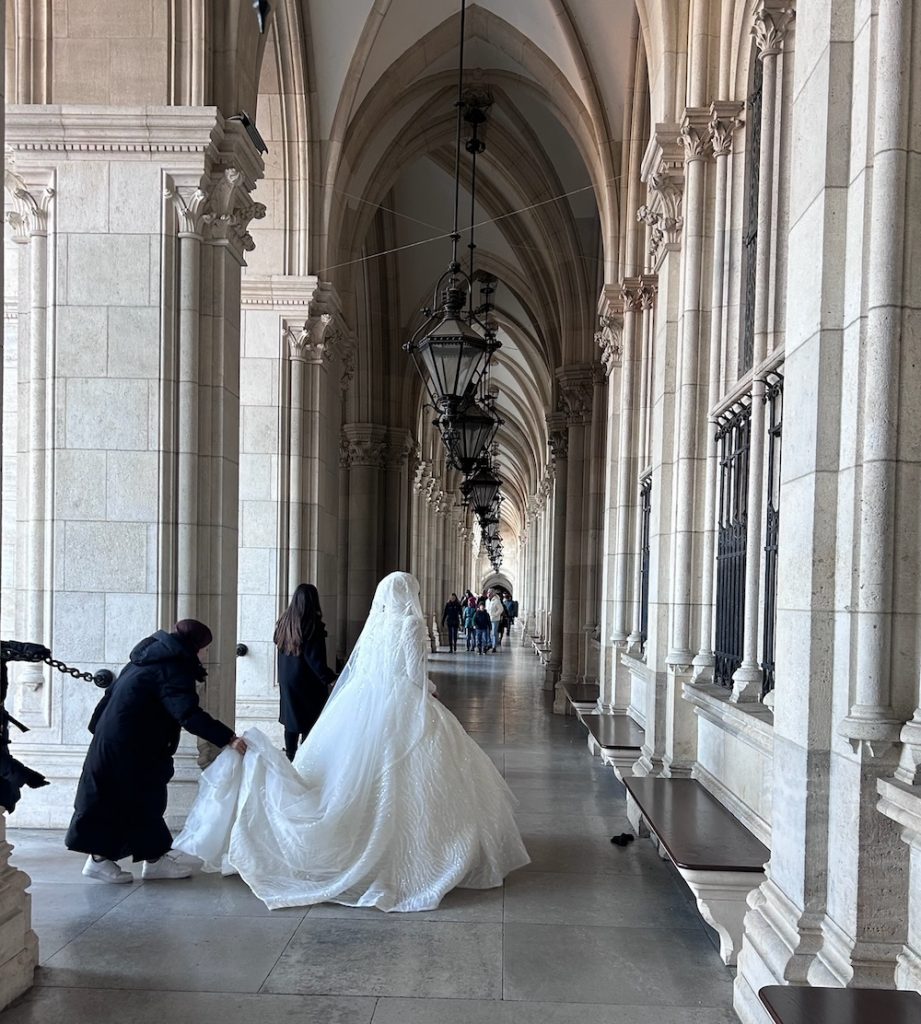
We spent Christmas morning looking at Rembrandt, Vermeer, and Bruegel, agog at seeing legendary paintings with our own eyes. Tumbling out of the rococo Kunst Historiches art museum built by Emperor Franz Joseph to house his art collection, we strolled through the grounds of the Hofburg palace, his place of official business. Everywhere we went, it was hard to avoid the “Empire Stuff”. Palaces, cobbled streets, and overall sumptuousness of everything.
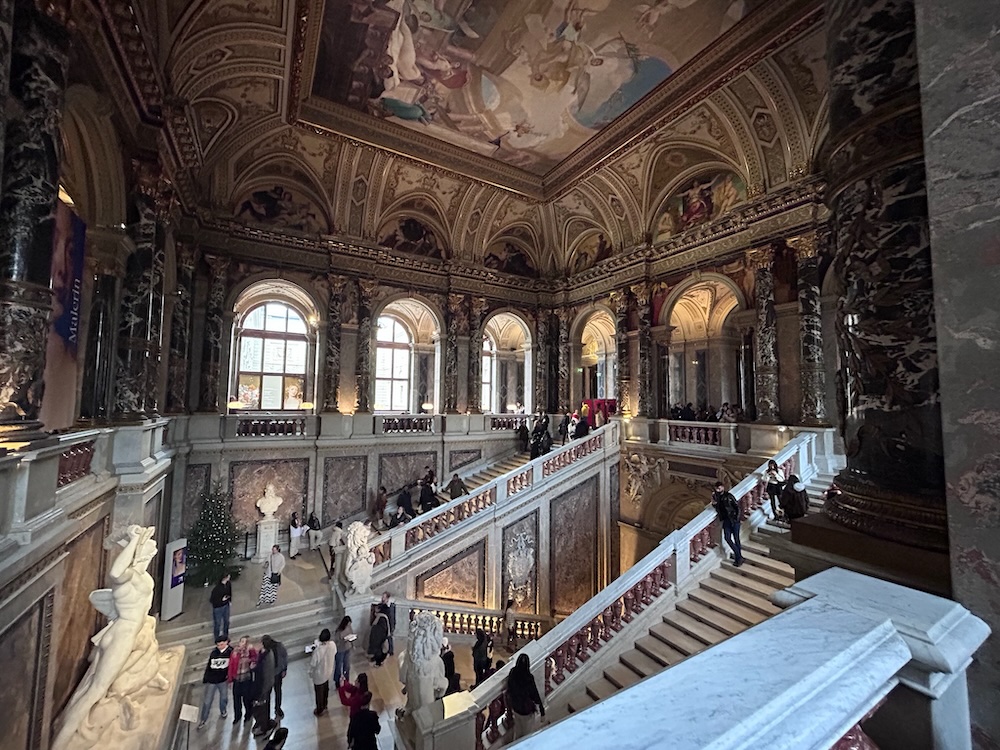
Certain cities seem to have an era imprinted into their being. Paris is still haunted by the 1870’s. Buenos Aires by the 1920’s. Over a hundred years have passed since the dissolution of the Austro-Hungarian Empire, but both Vienna and Budapest are still wrapping themselves in the glory of their 1890’s.
On Christmas afternoon, with cups of warm glögg in our hands, we strolled the straße und gasse, pondering the riches of Empire and if America would or could ever be viewed the same way. Do non-Americans see New York the way I see Vienna and Paris?
There’s more to Vienna I haven’t told you about, the Naschmarkt, with endless tasty foods and secondhand finds, stunning churches, strudel in coffeehouses, a cozy, family-owned wursthaus dating back to 1878, sipping spectacular local wine in a Heurigen. But the untold is merely evidence of Vienna’s depth. I hope I can get back.