
It was 1993, my junior year of college, and although I was set to live in dorms, that year my college installed high speed ethernet connections in campus housing. From the get go, I poured endless hours into the arcane text-based worlds of Gopher, FTP, and telnet, crawling campus computer systems across America, looking for chat board IP addresses and cool files to download.
My dorm mates, effortlessly cooler, shook their heads at my obsession. The screen’s glowing text – full of wonder to me – was mostly a curiosity to them. For me, it was all right there: You could connect to all kinds of people instantly, trading messages in seconds with California while sharing whole books for free!
That semester the Mozilla web browser was released, creating the world wide web. Things clicked into place. Everyone wanted a turn at the internet.
I became even more glued to computers. Collaborating at my school paper with an enterprising alumni, we launched WebSucker, which pulled news articles out of a Pagemaker document, formatted them with HTML and set them up for our student paper’s website.
When I went home on break, I breathlessly tried to explain to my clueless parents what was happening with computers. I tried to cajole my classmates to try out the internet for themselves. The world was changing! We could email each other and get an answer back in minutes, if not seconds. What a future!
For the last six weeks I’ve been experiencing some of that old breathlessness as I’ve experimented with AI.
Since I signed up for an Anthropic Claude Pro account, my evenings and weekends have been filled with vibe coding and other experiments. In the last six weeks I’ve built half a dozen web apps, used AI to scan and boil down an entire reference book, and built a handful of foreign travel itineraries as my family has debated its next overseas adventure.
Let me be clear: I am not a coder. I know some of the basics, but it’s kind of like knowing restaurant French: It’s not like I’m going to debate Voltaire with François. And yet, working with Claude I’ve built some very impressive systems that have really changed the way I work. Let me share two that I think portend a serious shift in how information works.
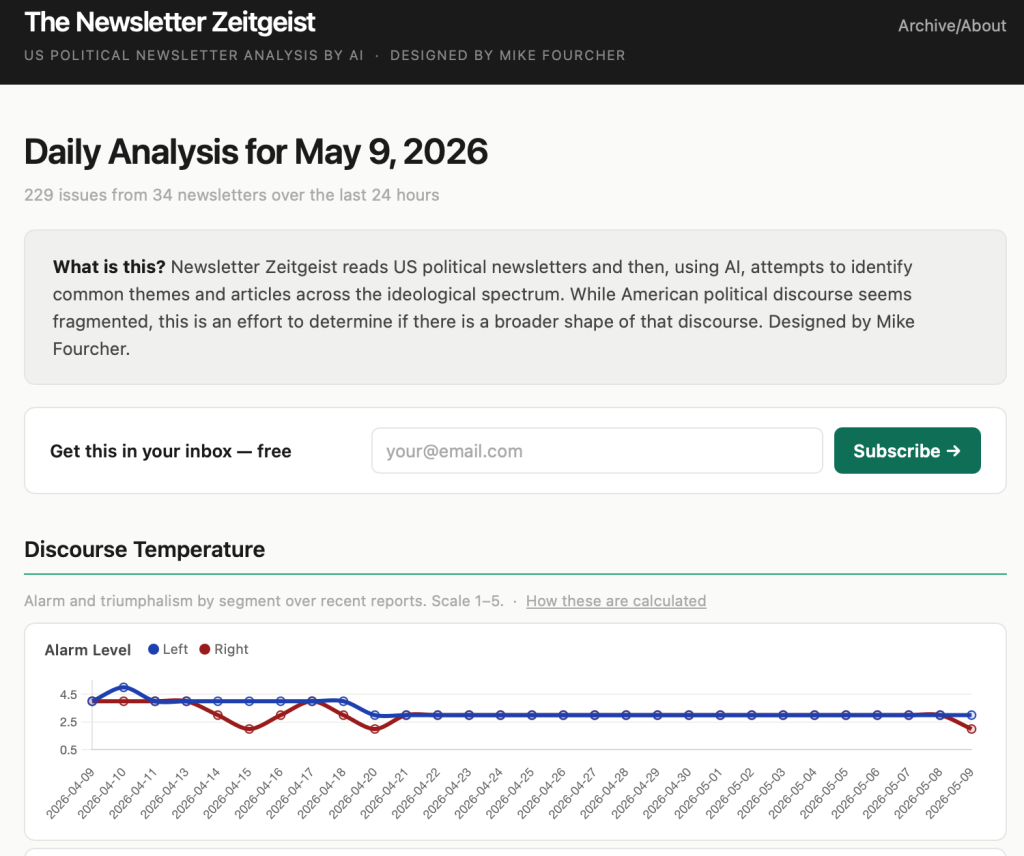
Newsletter Zeitgeist is a daily newsletter produced for me by Claude that every day ingests about 50 newsletters across the political spectrum, uses AI to look for similarities between them, and then automatically produces a summary, a zeitgeist. I’ve been running it for almost a month giving me a clear view of how the chattering class pushes us. With a month’s worth of data collected, I’m getting ready to produce longer term pattern matching – and I’ll start adding that soon. Check it out and subscribe (free!) If you’re interested.
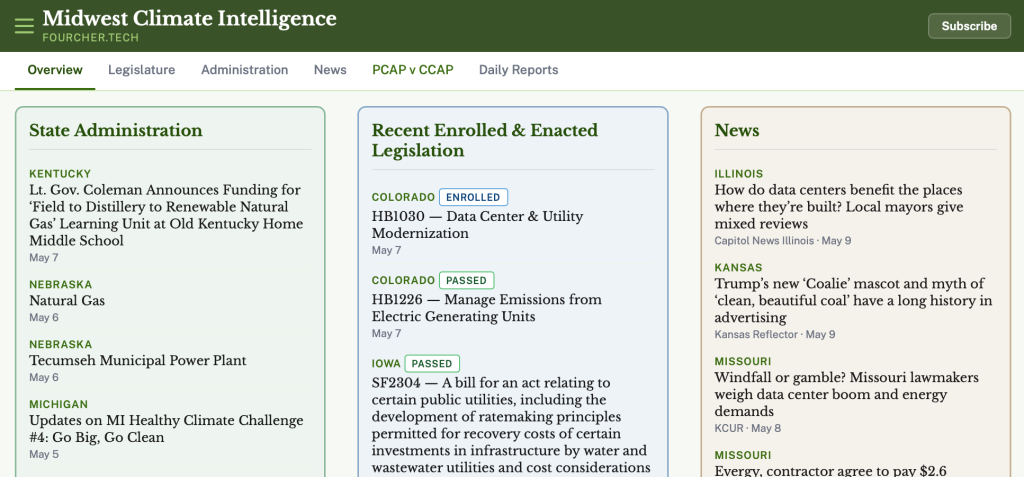
Midwest Climate Intelligence is a dashboard and weekday email I built to make my job easier. Part of my work is to track the energy doings of 14 states. So, I built a system that scrapes state administration pages, ingests press releases, follows state legislatures and news sites for anything energy or climate-related. It sends me an email every morning with an AI summarized digest but also runs a constantly-updated web site I can check for updates. I can quickly boil down legislative action and often, I see details days before industry news sites write about them. If you’re into state-level energy stuff in the Midwest, you can subscribe for yourself too!
This is a huge deal. My non-programmer self has created systems that only five years ago would have cost tens of thousands of dollars of developer time to build. The news services I’ve created gather information in meaningful ways that significantly change how I think about and react to the world, shattering the grip news providers have on collecting and distributing information.
As a news consumer – granted one that has a very specific niche need – I suddenly have explosive power. What used to cost five figures to collect and manage now can be done for less than $100 of compute time. Of course it lacks true insight and analysis a human reporter provides, but for someone looking for the daily quick and dirty, which is the core of any niche news report (think of Axios or a Dive newsletter), this is a whole new world.
Since the 90’s the news world has been talking about the atomic unit of news: A 300-word story? A graf? A tweet? But the processing power of AI has put lie to all of that: AI don’t care what form it comes in, it just consumes, grinds it up and spits it out in whatever form is needed. The “atomic form” of news was actually predicated on humans composing it in a standardized form that made it easy for humans to make. AI can make whatever whoever needs it whenever.
The real flow, the real question, is not the atomic unit, but the distribution system and the originality of data: What’s your API and is this the most basic source of information? For instance, an RSS feed of news reports on government actions is good, but an RSS feed of government press releases is potentially even better. Give me a pure drip of news – and make sure that your analysis stories are cleanly broken out so my AI can easily identify it when it generates summaries.
This applies to anyone in any kind of analysis business – not just news. We need to be clearly breaking out data from analysis built on hard-earned experience.
Let’s say you produce product reports. Now that I have AI, I’m not really interested in your 100-page analysis with charts and graphs. Instead, I’d like four pages of your biggest insights and recommended actions, along with a giant CSV file (don’t even bother with Excel pivot tables) of all your data. I can pour the data into my AI and make all my own graphs to my heart’s content. I’ll read your four pages of bulleted insights, use AI to review the data, and then quiz you on what your experience tells you.
You could apply the same thinking to basic news. For instance, for Ukraine war news I closely watch social media posts from the Institute for the Study of War for the daily happenings. But then to understand it, I read David Ignatius, Michael McFaul, and Phillip O’Brien.
AI is turning what happened into data. In the news business, I predict a future where on one hand we get clean data streams like the AP teletypes of old: spare, specific information, and on the other hand we get complex analysis derived from deep thinking.
What Else I’ve Been Thinking About
Will It Be Worth It? – I made this mini site that tracks electricity and gas prices across the US to give you an up-to-date measure of whether or not switch to an EV saves you money (spoiler: It does! But much more in some places versus others).
Beware Software Brain – Nilay Patel identifies the tendency of coder-types to view the world as a series of databases to be manipulated. This piece explains so much of why tech doesn’t address human needs as much as it seems to want to dominate humans. Also: See this SF AI coder experiencing NYC for the first time.
Six Characters – How the record locator on your airline ticket works and what it means.
The Banal Horror of Jimmy Fallon – There’s a temptation to view dwindling late night comedians as political. I view them as measures of our culture’s depth.
Taylor Dearden on The Pitt – Autism runs in my family, so Dearden’s portrayal of Dr. King was much appreciated. Ignore RFK Jr. This is what autism is often really like: Not a disability, a different ability.
The Greatest TV News Theme Ever – I will fight you on this. And the composer? 80’s crooner Richard Marx’ dad.
Sperm Whale Communication Parallels Humans – One day we’re gonna confirm they’ve been intelligent all along and the reckoning will be ugly.
Why free public transport doesn’t fix traffic (and what does) – Lots of counter-intuitive logic here.
How to Pronounce Châteauneuf-du-Pape – An evergreen favorite.
Is a “China shock” coming for the “big ag” food regime? – Lots of charts on how US agriculture has become dependent on exports to China – who in turn has become dependent on imports from the US and Brazil. There are signs China is making moves to end those dependencies – or at least use them as a trade weapon. This is not good news for America’s increasingly struggling farm sector.